Pontil Marks and Mold Seams: Reading Two Clues in Collectible Glass
A museum lamp with a blown bowl and pressed base shows why glass-forming and base-finishing clues deserve separate readings.
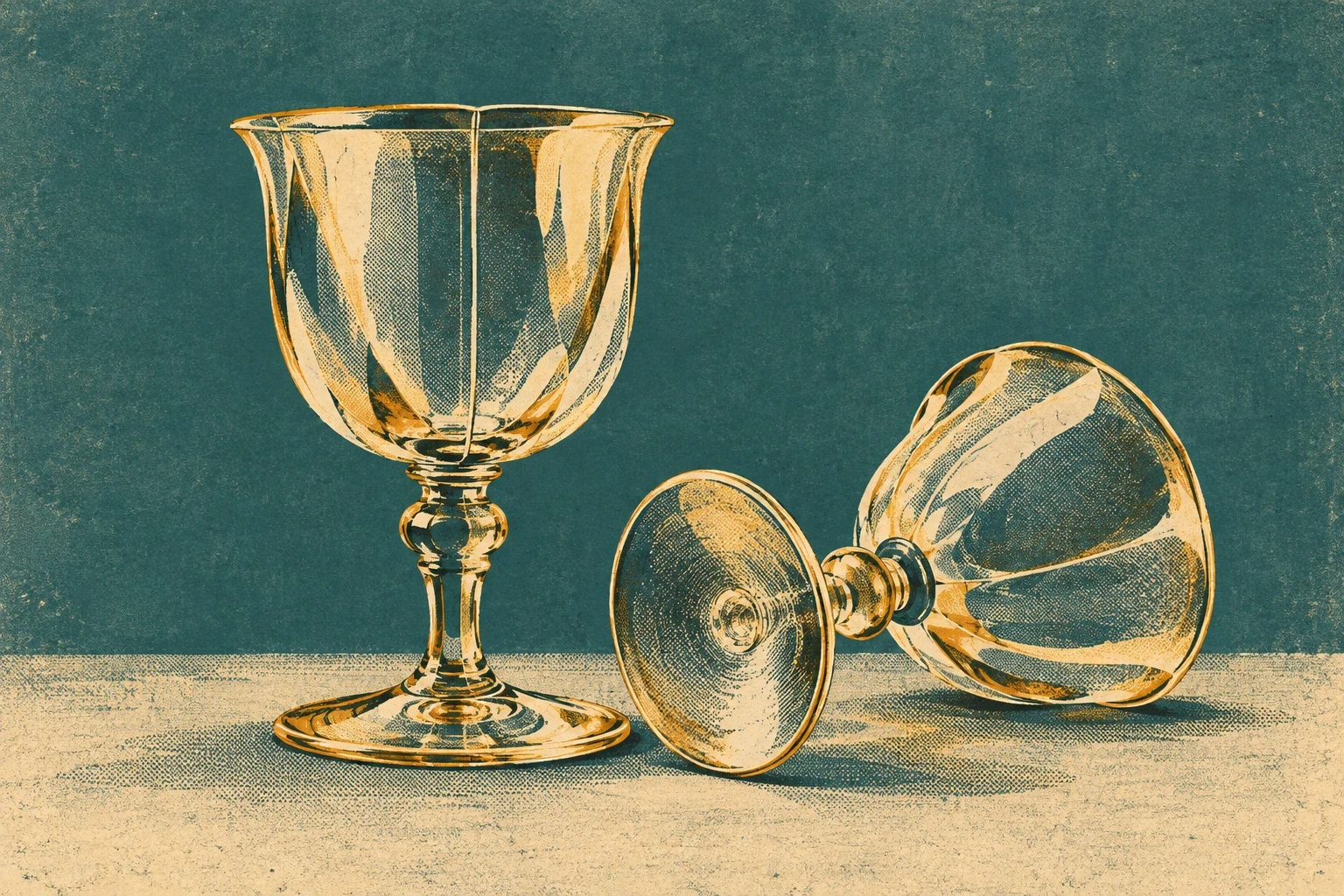
A small mark underneath a goblet can tell part of its making story. It cannot, by itself, choose between every version of “handmade,” “molded” and “antique.” A useful place to start is a surprising museum example: a glass lamp with a free-blown bowl, a pressed base and a pontil mark on that base.
For a collector comparing photographs, the practical question is therefore twofold. What evidence is there of shaping in a mold? What evidence is there of how the base was held or finished? Keep those observations separate before turning them into a description.
In this article
What a pontil mark actually records
The Corning Museum of Glass defines a pontil as a solid metal rod, usually carrying a small amount of hot glass, attached to a vessel's base to hold it during manufacture. Removing it can leave an irregular or ring-shaped scar.
That definition concerns a holding tool and its possible trace. It does not make every circular feature on a base a pontil mark. Nor does it assign a year, a factory or a country to an unfamiliar object. A seller's description of a mark remains something to examine alongside the photographs and supporting records.
In Corning's Saxon goblet, accession 90.3.7, the catalogue describes blown, cut and engraved glass, dated about 1736–1738, with a rough pontil mark. Several techniques belong to the same object: shaping, decorative cutting, engraving and finishing need not be competing labels.
Keep the direction of the evidence clear. This is a museum's description of its documented goblet. It is not a rule that another rough-based goblet must share that date or origin.
One object can combine different methods
The Metropolitan Museum of Art's American lamp, object 46.77.2a, b, combines a free-blown bowl with a pressed base of the cup-plate type. The museum also records a pontil mark on the base and dates the lamp broadly to 1800–1900.
This is a component-level comparison. Calling the lamp simply “blown” or “pressed” would leave out part of the documented construction. The catalogue is useful because it identifies which part was made in which way. It does not ask one mark to stand for the whole object.
Corning's green bowl, accession 86.4.135, offers a different lesson. Its technique field says pressed and tooled, and its description records a ring pontil mark. The fuller explanation is cautious: the bowl was probably pressed in a tumbler mold and then tooled into its shallow shape, although it may have been mold-blown.
That uncertainty belongs in any comparison. The short technique field is not permission to delete the qualification in the detailed text. The bowl demonstrates why a collector should read beyond the headline, while the Met's lamp gives a clear example of different forming methods within one object.
A missing seam leaves a question open
The Corning Museum's explanation of molds adds another useful distinction. Blow molds can have seams, while turn molds used for symmetrical forms can produce no seams. The museum also distinguishes a mold that supplies a pattern from one that gives an object its final form.
So “I cannot see a seam” is a useful observation. “Therefore no mold was used” goes further than that observation supports. Photographs may also leave part of the surface unshown. Record the area actually visible rather than extending a negative finding to the whole vessel.
The same restraint works in the other direction. A line that looks like a seam deserves a clearer image and comparison with an appropriate reference. Calling it a seam before that check may build the rest of the description on an uncertain starting point.
A two-part note you can use
For an unfamiliar piece, make a short note under two headings. The following is a comparison aid, not an authentication test.
1. Shaping evidence: Which lines or repeated features can you actually see? Where do they run, and which areas are missing from the photographs? Has a reliable record identified the method, or is it still a visual possibility?
2. Base and finishing evidence: Is the entire underside shown? Describe the location and appearance of the feature without assuming its name. If a specialist or catalogue calls it a pontil mark, preserve that attribution and its source.
Add a third sentence only when you have support for it: maker, date and the reason for that attribution. “Unknown” is a useful entry. It keeps an incomplete view from becoming a confident history.
Work through one caption correction
Imagine an auction photograph captioned “Early hand-blown goblet, proved by its polished pontil.” This is an illustrative example, not a real listing we have assessed.
The caption joins three claims: an early date, a forming method and an interpretation of the base. A better provisional note would be: “Goblet with a polished area at the center of the base; forming method, maker and date not yet established. Request clear views of the side pattern, rim and entire underside.”
Once a specific reference genuinely matches, the note can become more informative. The Met's lamp can be described using the separate methods recorded for its bowl and base. Corning's green bowl needs the catalogue's uncertainty preserved. The lesson is to earn each part of the description separately, rather than transfer the museum's identity to a look-alike.
Look without altering the evidence
Use photographs and ordinary visual inspection. Do not scrape the base, polish a mark, run a finger over a sharp area or tap the glass to settle this question. A vulnerable or damaged piece should not be repositioned merely to complete a checklist.
Surface condition is a separate subject. If cloudiness is obscuring what you can see, our guide to cloudy antique glass explains why the next step deserves care before any cleaning attempt. A cautious description can remain useful while a material or condition question is unresolved.