How Silver Tea Services Come Together: Three Museum Stories for Collectors
What should “completing the set” mean? Three museum accounts offer different ways to think about an inherited silver service and its next addition.
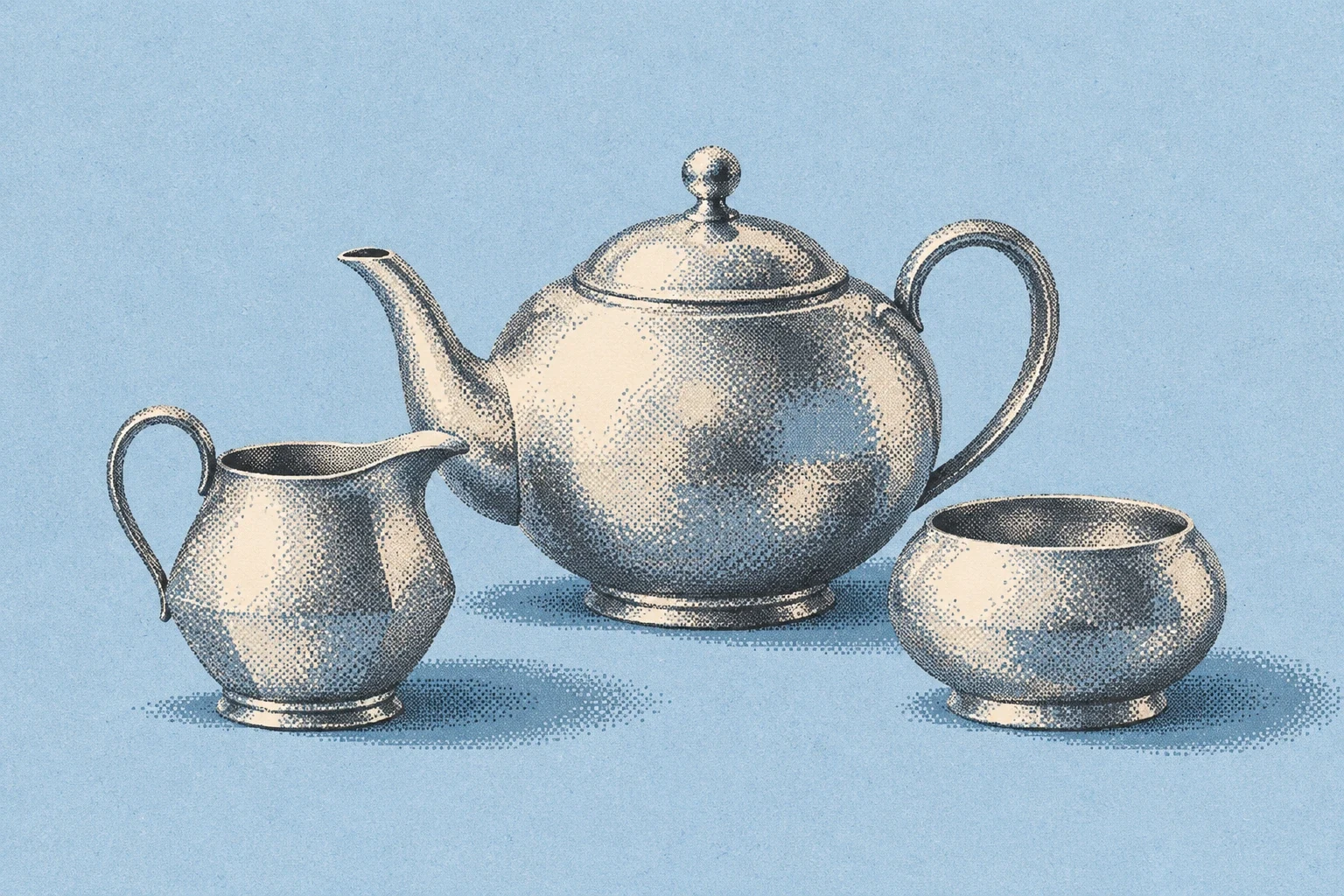
An inherited tea service can start to feel unfinished when one piece looks different or a familiar shape seems to be missing. Before looking for an addition, decide what you want the group to become: a record of a household, a collection you enjoy seeing together, or a reunion of particular objects with a shared past.
Three museum accounts give those choices substance. Read together, they suggest ways to think about collecting, rather than a formal classification of silver services. The aims can overlap, and each asks something different of the next piece you add.
In this article
James Logan’s service: several makers, one household association
In its account of James Logan’s tea equipage, Stenton describes a service made by several English makers between 1720 and 1724, then engraved with Logan’s cipher. The household association survives in the museum’s account alongside that mixed manufacture. See Stenton’s research on Logan’s tea service.
This makes assembly part of the story worth preserving. A collector interested in a household’s possessions need not make uniform manufacture the whole definition of belonging. In the Logan example, the significance lies in the account connecting the objects to a person as well as in the objects themselves.
That lesson depends on the documented example. Different makers on another group would leave its household history open for investigation. Stenton’s account cannot supply a missing connection for pieces in someone else’s cabinet.
Martelé at the Huntington: artistic coherence in an unmatched group
The Huntington’s label for its Gorham Martelé tea service explicitly describes the group as unmatched. It also draws attention to the curved forms and handmade character that connect the pieces artistically. Both observations appear in the museum’s Martelé cup record.
There is a collecting possibility here: you can value the relationship between shapes and surfaces while retaining an accurate description of the group. A coordinated display has a purpose of its own. It need not carry a claim that every object began in one matched commission.
The label does not identify who assembled this group, when that happened, or why. Its artistic description therefore offers a way to think about visual relationships, without giving us an assembly story to retell.
The Harrod service at NOMA: a reunion across decades
The New Orleans Museum of Art records a more specific kind of coming together. According to its account, Eugenia Uhlhorn Harrod donated the service’s teapot and waste bowl in 1914. The museum reports their reunion with the sugar bowl in 1986, after that bowl appeared at a local auction. See NOMA’s waste-bowl record.
Here the reunion concerns a particular sugar bowl and its relationship to particular companion pieces. A similar-looking bowl would answer a different question. Visual resemblance, even with a shared monogram, is insufficient on its own to establish a reunion.
NOMA’s short entry reports the reunion but does not set out the identification process or a continuous history of the separated bowl. We can attribute the account to the museum while leaving those details unresolved.
Choose the relationship you want to preserve or build
The three cases suggest different starting points for a collecting decision:
- If a household association matters most, preserve the grouping and the account of how it was kept together. Differences between its pieces may be part of the history you want to retain.
- If visual coordination matters most, choose additions for the relationship you want to create and describe them as your additions.
- If historical reunion matters most, look for evidence connecting the particular objects. Keep the reunion claim open until that connection is supported.
These are choices of purpose, not a ranking of collections. A historically associated group can also be visually pleasing; a collection assembled today may later acquire its own household story.
Alex’s choice: keeping the family group and naming the addition
Consider an explicitly fictional collector, Alex. Alex inherits a pot and creamer that family members remember seeing displayed together. Their makers and earlier ownership are unverified. A newly found sugar bowl looks compatible, and Alex initially thinks of adding it to “complete the original set.”
The family recollection gives Alex something specific to preserve: what relatives remember about the two inherited objects. It does not establish that the pieces were manufactured together or shared an earlier owner. The newly found bowl’s appearance supplies no historical connection to either one.
Alex decides that preserving the inherited grouping matters most, and also chooses to add the bowl for a coordinated display. The collection note can now say: “Pot and creamer inherited together; family members recall them displayed together. Sugar bowl added by Alex for its visual compatibility. An earlier connection between the bowl and the inherited pieces has not been established.”
That last sentence leaves room for future evidence. A connection that has not been established is not proof that the bowl never belonged with them. For now, Alex has an inherited group and an honestly described addition.
Someone whose priority is historical reunion could make a different choice and wait for a supported connection. The useful decision comes before the search: what relationship would make another piece worth adding to your collection?
For a separate example of researching ownership events, see our painting auction-provenance guide.