British Registration Diamonds: When a Teapot Design Appears on a Plate
A Samuel Lear oyster plate was linked to a registered design represented by a teapot. Learn why the design's scope matters as much as its date.
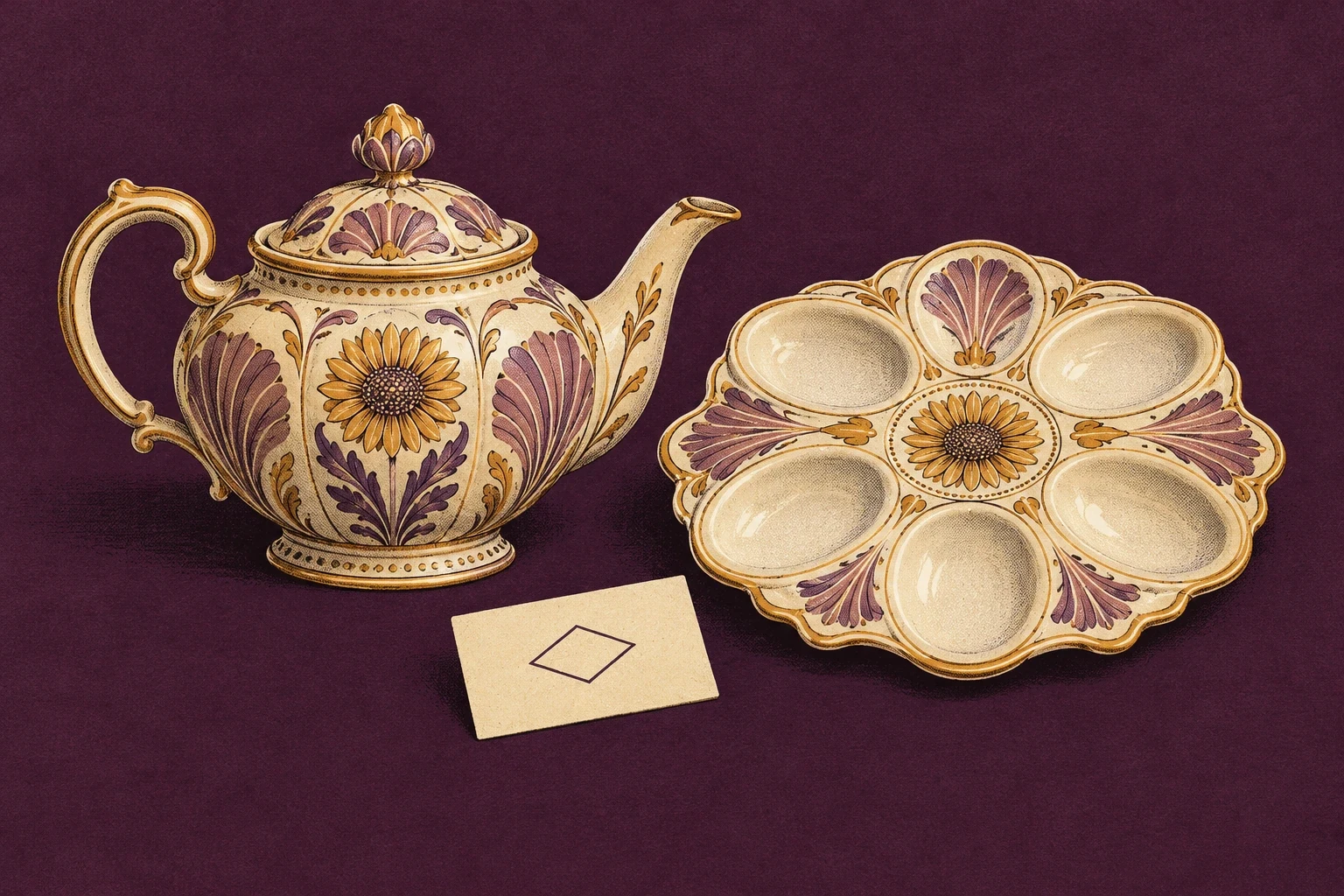
Finding a British registration mark can feel like finding the missing answer to an antique's identity. But a decoded date is only the start of a comparison. You still need to ask what was registered: the object's shape, its decoration, or something more limited.
The Walters Art Museum documents an instructive case: an oyster plate associated with a design represented on a teapot.
In this article
The plate and the teapot photograph
The Walters catalogues its oyster plate, accession 48.2985, under Samuel Lear and gives its date as “design registered 1882.” The underside inscription is identified as a British Designs Registry diamond for May 27, 1882, parcel 3. The museum explains that the submitted representation showed a teapot carrying the pattern.
That decoration combined sunflowers in classical-style urns, fans and geometric ornament. The Walters object record explains its use across several forms. Rejecting a reference merely because its silhouette differs can therefore miss the relevant comparison.
This example does not mean that every registration diamond concerns decoration, or that every vessel with sunflowers belongs to the same registration. It shows why the scope of the registered design must be checked before a difference in shape is treated as a contradiction.
A registration record has more than one component
The National Archives' registered-designs research PDF distinguishes a design representation from the associated register entry. A representation might be a photograph, drawing or sample. The register can identify the proprietor, who is not necessarily the designer or manufacturer. Those are different kinds of evidence, even when they relate to the same registration.
The guide also warns that a registered number may concern part of an object, such as a handle, lid or embellishment. A useful comparison therefore asks both “Does this record belong to the mark?” and “Which feature of the object does the record describe?” Finding a plausible date without answering the second question leaves the identification unfinished.
For an unknown piece, the relationship between registration and object still has to be established. A familiar silhouette cannot substitute for that work.
Separate the mark, the design and the object date
Keep three entries in your notes. First, a literal transcription or photograph of the mark, preserving unreadable characters as unreadable. Second, the registration information supplied by the reference, with its exact source. Third, the proposed production date of the object and the independent evidence supporting it, if any.
The date of registration records an event in the history of the design, not automatically the day a particular object was made. Dropping “design registered” from a catalogue date changes the meaning of the evidence.
The same discipline applies to names. A proprietor named in a registration record should initially be recorded as the proprietor. If you want to describe that person or firm as the maker of the object, explain the additional connection rather than silently changing the role.
Work through an apparent shape mismatch
Imagine a collector finds a decorated plate and a reference photograph of a teapot under a seemingly relevant registration. The first question should not be “Which picture is wrong?” Ask instead whether the registration is for the form, the ornament or a component. This is a hypothetical research exercise, not an attribution of another Lear object.
Compare the same feature on both sides. For decoration, note the arrangement of motifs and borders, not just the presence of one flower. For form, compare the profile and construction described by the record. If only a component is involved, make clear that the comparison concerns that component rather than the whole vessel.
Then record the outcome in plain language. “Shape differs, but the reference identifies a decorative pattern used across forms” is a different conclusion from “shape differs and the record concerns the shape.” A third result, “registration scope still unknown,” is perfectly usable. It tells the next researcher exactly what remains to be resolved.
When a search does not produce a match
A failed lookup is not an authenticity verdict. The Tiles & Architectural Ceramics Society describes its own registration-number research as incomplete and notes inconsistencies among sources. That statement concerns its tile database; it should not be stretched into a claim about every ceramic reference. It is a good reason to read a reference's coverage notes before interpreting absence from it.
For a partial mark, save a clear overall photograph and closer views from different lighting angles. Record alternative readings rather than selecting the one that gives the most attractive date. The National Archives also identifies worn or damaged numbers and missing or damaged records as practical research problems. Do not scratch, chalk, ink or clean a mark to improve the image.
Write a description that preserves the connection
A cautious description of an unresolved piece might read: “Registration mark partly legible; reference match provisional; scope of registered design not yet established; production date unconfirmed.” Once a match is supported, add what is actually registered and cite the record. Leave the uncertainty visible instead of burying it behind a confident year.
For the broader image set, our ceramic listing photograph and condition guide covers the views that help another reader follow your evidence. A registration diamond is most useful when it leads to a better comparison. The aim is not merely to decode a mark, but to understand what connects that mark, that design and that particular object.