Jasperware Is a Material, Not a Maker: Wedgwood and William Adams
A Wedgwood jasper-dip cup and a William Adams jasper teapot show why material, colour and maker need separate evidence.
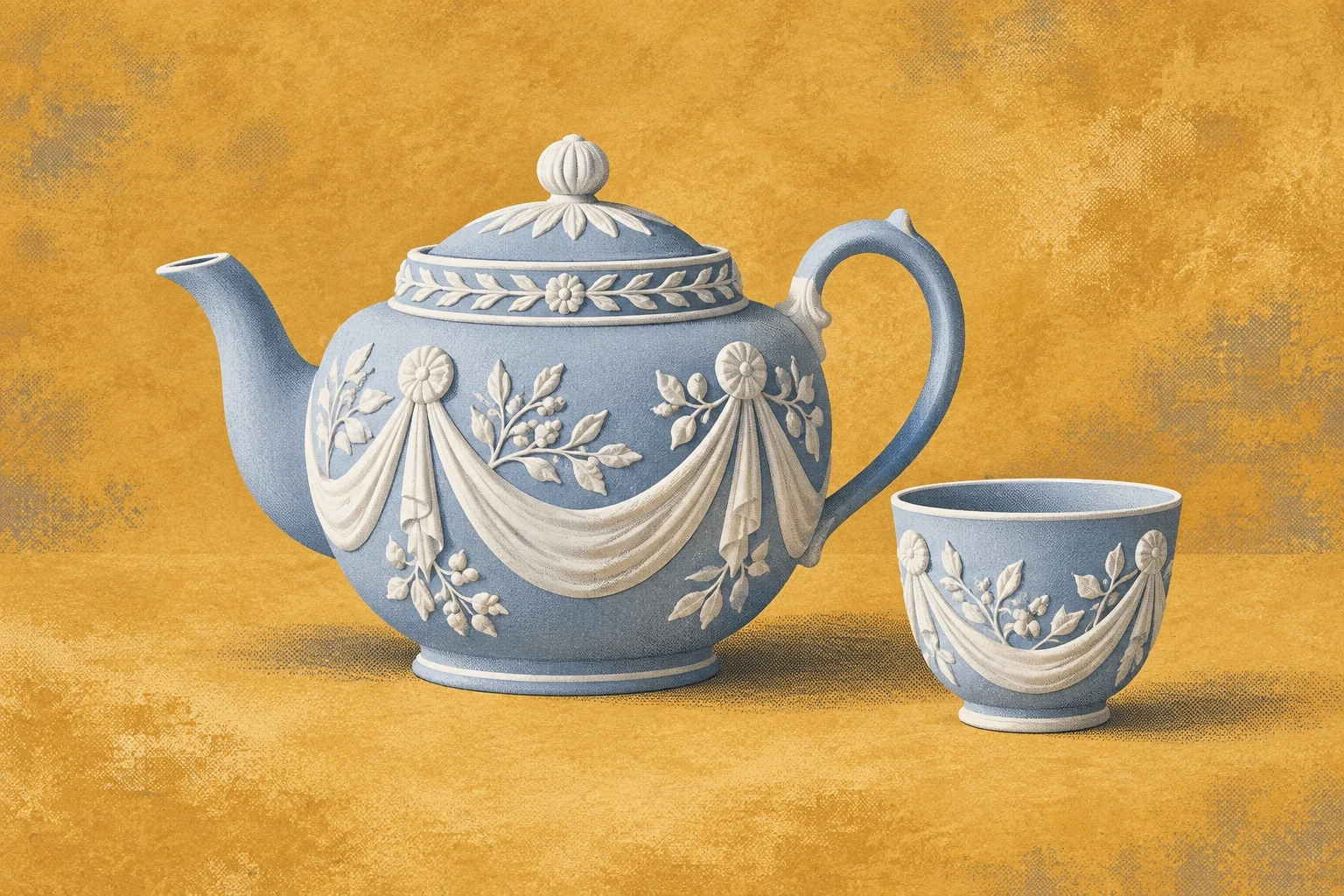
A blue ceramic vessel with white classical figures can look immediately familiar. Calling it jasperware may be a useful starting point. Calling it Wedgwood is a separate attribution, and one that colour and ornament cannot settle on their own.
Two museum records make the distinction tangible: a Wedgwood cup catalogued as jasper dip, and a blue jasper teapot catalogued under William Adams. Read their maker and material fields separately and the apparent contradiction disappears. Jasperware describes a ceramic type; it does not reserve every object in that type to one factory.
In this article
What the material name tells you
Wedgwood's own jasperware explanation describes a dense white stoneware capable of taking colour throughout its body, developed by late 1774. That history explains the strong association between the material and the Wedgwood name. It does not identify an unexamined blue-and-white pot.
There is also a material distinction within the category. The Fitzwilliam Museum explains that jasper was made in white or with colour through the body, and also with a surface application of coloured slip. “Solid jasper” and “jasper dip” therefore concern how colour relates to the body. Neither phrase, standing alone, names a maker or provides a production date. The museum's jasperware catalogue note also records other factories making their own versions.
This is why a search for “blue and white Wedgwood” can become circular. If the maker is assumed in the search phrase, the results may reinforce the assumption without testing it. Start with the visible object and keep a separate question for who made it.
The Wedgwood cup: a precise material field
The Metropolitan Museum of Art's cup, object 14.132.49, is listed under the factory Josiah Wedgwood and dated to the late eighteenth century. Its medium is specifically jasper dip. The complete cup record separates those fields rather than using the maker's name as the material description.
That example answers one practical question: the word “dip” is not, by itself, a reason to reject a Wedgwood attribution. It also warns against replacing the museum's broad date with a guessed year. “Late eighteenth century” is the evidence supplied for this cup; a more exact date would need more evidence.
The cup is a reference example, not a template that authenticates another piece with similar colours. An online resemblance should lead to a closer comparison, not a copied catalogue identity.
The Adams teapot: a different maker in the same category
The Fitzwilliam's teapot, EC.31.2 & A-1942, is catalogued with William Adams as its pottery maker and a production date of about 1799. The description identifies blue jasper with applied white classical scenes. Its cylindrical body, straight spout and raised loop handle provide specific features to compare beyond the colour scheme. See the teapot's object record.
This object provides a useful counterexample to the idea that blue jasper with classical relief must be Wedgwood. It does not establish that an unknown teapot is Adams instead. Replacing one unsupported maker with another would repeat the same mistake.
Nor should the two records be forced into a neat solid-versus-dip pair. The Met explicitly identifies its cup as jasper dip. For the Adams teapot, keep to the object-specific description rather than upgrading a general discussion of jasper production into a firm classification of that particular body.
Compare four fields, not one overall resemblance
For an unknown piece, create four short entries: visible material characteristics, form, decoration and maker evidence. Under material, record what can actually be seen: a matte-looking blue surface, white relief, and the appearance of already exposed areas. If the colour-through-body question is unresolved, leave it unresolved. Do not scratch, chip or abrade the pot to settle it.
Under form, note the profile, handle, spout, foot and cover where present. Under decoration, record the arrangement and framing of the figures, not just “classical scene.” Under maker evidence, transcribe any legible mark exactly and retain a photograph showing its position. Keep the seller's attribution in a separate note if it has not been independently supported.
Now compare those entries with a museum record. A matching colour belongs in the material column. A similar figure belongs in the decoration column. Neither should silently fill the maker column. Even several visual similarities are a research lead rather than a complete attribution.
A useful change to an uncertain description
Imagine an unmarked blue-and-white teapot described as “Wedgwood, solid jasper, circa 1800” solely because it resembles a museum image. That sentence contains three conclusions: maker, body treatment and date. Each needs its own support. This is an illustrative case, not a judgement about an actual listing.
A more informative interim description would be: “Blue-and-white relief-decorated teapot, provisionally described as jasperware. Maker, colour-through-body treatment and date unconfirmed. Full profile, base and visible interior photographs supplied.” If the ceramic type itself is uncertain, say “jasperware-style” rather than claiming a material identification.
The next useful request is specific: “What evidence supports the named factory, and is there a reference matching the form as well as the decoration?” A readable mark, a well-documented provenance or an appropriate specialist comparison may change the assessment. Another front-facing photograph with the same colours may not.
Keep identification separate from intervention
Do not rub the relief with a fingernail, remove a mount or clean a faint mark to make the comparison easier. An incomplete view is a limit to record, not a reason to alter an object. General manufacturer care advice also should not be treated as permission to wash an antique with unknown repairs.
Our ceramic listing photograph and condition guide can help organise the supporting views. The useful lesson from these two jasperware records is simpler than an authentication checklist: preserve the distinction between what a pot is made of and who made it. A careful description can be valuable even while the maker remains unknown.